
You can’t manage corporate partnerships by yourself; you need the whole organisation. But what happens if your colleagues don’t know that? It’s probably not in their job description, KPIs or skill set. They don’t see the road, let alone know the rules.
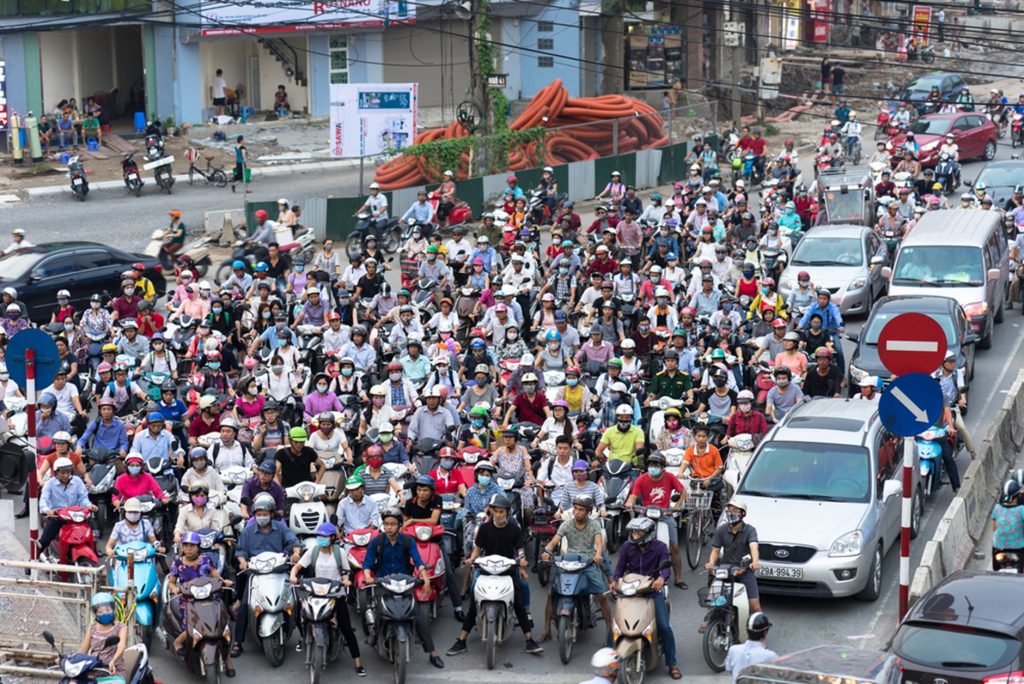
If you ever visited an Asian city, you’ll be overwhelmed by the traffic. I once navigated a big roundabout in Hanoi and was confronted by about 12 lanes of scooters, tuk-tuks, cars, bicycles, taxis and trucks. I say lanes, but they were only defined by how many vehicles could fit side by side on the road. It looked crowded, chaotic and terrifying. But somehow it worked. It was a motorised ballet where drivers weaved, found gaps, avoided obstacles (including me!) and got to their destination.
When nonprofits embark on corporate partnerships, it’s equally chaotic, as no one has learnt the rules of the road. How do you avoid a mass pile-up and ensure everyone’s in their lane?
Why does traffic work in places like Hanoi and not cause gridlock? A few reasons:
Most of the vehicles are small and nimble.
It’s hard to manoeuvre a monster 4WD as you’ll never be able to squeeze into the gaps. Food for thought for the bigger nonprofits that can be slow to respond to new opportunities. Are your smaller and more entrepreneurial competitors slipping past you into the gaps? Check out Cherished Pets, the world’s first BCorp vet practice, focusing on the human animal bond. It’s a unique mix of social care and animal welfare, carving a new path in veterinary work.
A ‘flow’ mentality.
Traffic moves like a river, continually adapting to changes rather than stopping at predictable lines. How often does your organisation get stuck at the lights because that’s what they’ve always done? Dolly’s Dream started small and hustled hard to get partners, profile and income. Their last fundraising day raised $1.9mln in income and over $15mln in free media. They’re a constant motion machine and building awesome momentum.
Lanes form, reform and often get blurred entirely.
If everyone stayed in a marked lane and queued, there’d be a gridlock for miles. Vehicles of all shapes, sizes and speeds move seamlessly with each other. Successful corporate partnerships need inputs from so many different departments: marketing, HR, finance, programs, volunteers and leadership. Each opportunity is different and the mix of inputs will flex and change in response. Nonprofit specialists will be needed from a variety of departments depending on the nature of the partnership. They’ll need to get comfortable with forming and reforming around each opportunity. When RFDS QLD secured a partnership with Rio Tinto, they needed specialists across both organisations to figure out how to make the biggest impact on rural and regional health. The outcome was a $14.675 million partnership over five years. We see this pattern repeatedly in our work and talk about it in Partnerships Reimagined: the most successful partnerships are powered by organisations that treat collaboration as a shared capability, not a specialist function.
They communicate with each other.
In Hanoi, it’s usually with horns, but not to angrily assert oneself; rather it’s to signal intent, or to announce a presence. Communication between drivers is essential to avoid collisions, warn of obstacles and keep everyone alert. I wonder how many times corporate partnership teams are working in isolation. Other departments are not communicating their priorities, and the latest thinking or partnership people omit vital colleagues from partnership information. I once launched a new cause marketing campaign with a corporate partner and forgot to tell the customer service helpline team. They were flooded with enquiries about a high-profile campaign they knew nothing about. Cue gridlock on the phones and abject apologies from me.
The road rules are understood by everyone.
Imagine inserting a German used to driving on an autobahn into Hanoi traffic. There would be frustration at the speed and a collision at the first intersection. Road rules are not simply the ones that are codified into manuals or procedures; they’re learned and absorbed over time. I doubt that much of the formal highway code in Hanoi is followed to the letter, but the principles are commonly understood by everyone.
How many of your fellow nonprofit colleagues understand the principles of corporate partnerships? Could you take the time to include them in discussions, introduce them to partners and peel back the mystery curtain that hides corporate partnerships? I used to insert myself into induction training for new recruits and get them exposed to partnerships in their first weeks. Lunch and learns, briefings and collaboration help everyone understand the road rules for partnerships and ensure you’re all travelling in the same direction.
You have a choice. You can have a smooth flowing, flexible and effective way of moving forward with partnerships. Or you can deal with the stress of a Mad Max style collision, conflict and chaos way of working. Establish the right road rules and you’ll be well on the way to success.