
The latest Edelman Trust Barometer report for 2026 has just landed and the theme is Trust Amid Insularity. From their first report in 2001 when NGOs were rising in influence and the first iPod was launched, the world in 2026 looks very different.
The latest Edelman Trust Barometer paints a picture of a far more fragile society: people are retreating into their own circles, sceptical of institutions and wary of anyone who feels “different.” This matters because corporate partners are making decisions in that same climate of fear, risk and fragmentation. You could approach corporate partnerships in 2026 as if trust is abundant, shared and automatic but you’re playing yesterday’s game. To win and sustain corporate partnerships, NGOs don’t need to be louder or more visible; they need to be trusted by business to help navigate a fractured society.
Here are the latest highlights from the Edelman report and the implications for your partnerships strategy.
The trust market has changed
Edelman’s central finding is that trust has become more insular. Globally, 7 in 10 people have an insular trust mindset. They are reluctant to trust anyone who is perceived as different. The increasing polarisation of the COVID years has nurtured higher levels of grievance, leading to greater insularity. Trust has gone local as people wrestle with concerns over the economy, cost of living, disinformation and the rise of AI.
The shift of trust away from NGOs and towards business continues, as business is clearly viewed as the most competent and ethical institution. NGO trust is neutral and shows no increase.
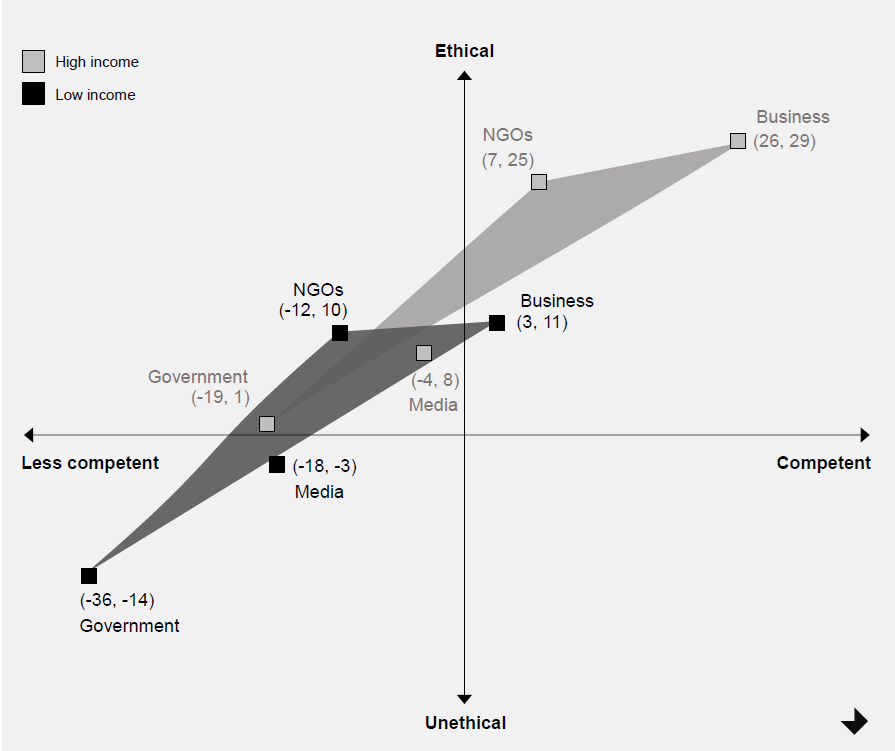
Nonprofits can no longer assume the virtuous ‘charity halo’ will carry partnerships. In 2026, NGOs must borrow trust strategically, through business credibility, measurement, and operational competence, while protecting mission integrity.
The employer advantage
‘My employer’ is the most trusted institution globally and sits well above government, media or NGOs. Trust has shifted from We to Me as people turn to their close circle of family friends and neighbours, their co-workers and even their business CEO to help navigate societal shifts.
Your strongest path into corporate buy-in within this insular environment is often inside-out: helping build workplace culture, employee experience, skills-based volunteering tied to real community needs, internal storytelling kits for staff and team-based impact and then scale up. Employee first partnerships will outperform the more traditional philanthropic approach when a business is more focused on internal cohesion and trust building.
The income divide in trust
Only 32% believe the next generation will be better off. Job and trade/tariff worries are at all-time highs among employees. However, the trust gap between high and low income employees has more than doubled since 2012. Average trust for the top 25% of earners is at 68 pts, whereas the score of the lowest 25% is only 48pts. Undoubtedly, the lowest earners are being the hardest hit by rapid societal changes and have less of a buffer to ride the turbulence.
You may be seeing this play out with a growth in HNW giving whilst your regular, mum and dad individual givers are stagnating. If you want to scale individual giving, you may need to lean on the employer advantage to access new donors and leverage business trust. In future, corporate partnerships will be judged less on “awareness” and more on practical outcomes: affordability, jobs, skills, resilience, and local benefit.
The challenge for global brands
People trust domestic companies more than foreign companies and Edelman explicitly says multinationals need a “polynational” approach centred on long-term local relationships. If you’re working with foreign headquartered corporates, design partnership concepts that visibly benefit specific local communities over time. Build in local hiring, local suppliers, and place-based outcomes to demonstrate genuine impact on local people. Local investment with local faces will be key to helping global corporates improve their brand and employer trust.
Brokering trust- a new value proposition
Edelman frames “trust brokering” as the response to the new insularity: helping groups cooperate across difference. The #1 trust-building action for business in divisive moments is ‘encouraging cooperation without taking a side’. The report also calls out a new role for NGOs in “translating between groups”- that means facilitating trust across the difference divide, surfacing common interests and proposing solutions to common problems.
In this way, your nonprofit’s value proposition expands. You’re not just delivering impact, you’re helping companies operate in a fractured society without inflaming it. It enhances a corporate’s resilience, license to operate and workforce cohesion.
Key elements for your partnership strategy
- Emphasise local legitimacy by prioritising local hiring, local suppliers and community-level impact.
- Build partnerships and donor bases through the employer channel, leveraging employer trust to create internal champions and lower perceived risk.
- Demonstrate competency and ethics through strong governance, consistent delivery and measurable benefit.
- Position your nonprofit as a trust broker, not a cause seller — with a practical blueprint for bridging divides.
Partnerships in 2026 are no longer just alternative funding mechanisms. You’re building a trust infrastructure that will break down insularity and position you as the trusted broker and facilitator. We are entering a new era of low trust across society. Working in partnership with corporates and businesses will allow your nonprofit to leverage their trust assets and build a stronger position for your other fundraising streams.
Want to explore a new approach to partnerships? Or reframe your partnership pitch through a trust broker lens? Book a call with us.